The big picture Ranking #1 ≠ getting cited
The Gap
- 18,377 queries studied
- Google ranks ≠ what AI cites
- LLMs use their own authority signals
Perplexity
- Live web indexing
- 43% domain overlap with Google
- Classic SEO still matters here
ChatGPT & Gemini
- ChatGPT: 21% domain overlap
- Gemini: just 4% domain overlap
- Reward density, not backlinks
What Changes
- Structured data is baseline, not bonus
- Goal shifts to "cited source"
- Citation engineering over keyword SEO
The Search Disconnect
For over two decades, the goal of search engine optimization was simple: rank in the top three positions on Google. The rise of Large Language Models and AI-powered search has disrupted that paradigm. Top-ranking pages are now frequently overlooked by AI agents in favor of denser, more logically structured sources.
The Citation Gap Is Real (and Quantifiable)
Takeaway: High Google rankings do not guarantee AI citations — LLMs use distinct criteria for authority.
A Search Atlas study of 18,377 matched queries reveals a stark divergence between traditional search results and AI citations. While Google prioritizes a mix of authority, relevance, and user-experience signals, AI models look for specific data that satisfies their internal reasoning requirements.
According to the Search Atlas study, “Large language models cite sources differently than Google ranks them.”
Perplexity: The Bridge Between Old and New
Takeaway: Live-retrieval models act as a structural bridge, maintaining strong domain alignment with legacy search.
Because Perplexity performs live web indexing to synthesize answers, its results mirror Google more closely than its competitors. The data shows two distinct metrics: a median domain overlap of 25–30% per query, and a broader measure showing that 43% of the total unique domains Perplexity cited also appeared in Google’s results, alongside a URL overlap of roughly 20%.
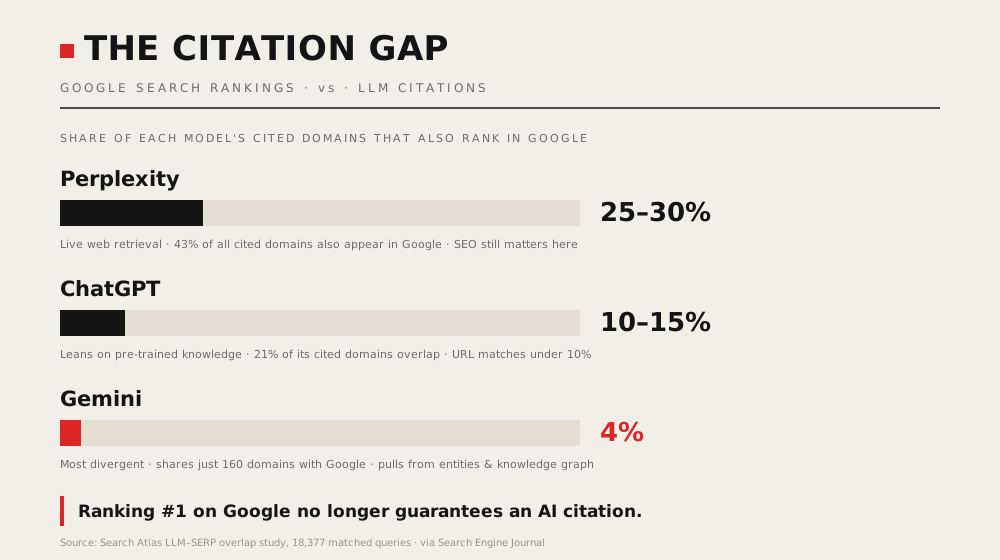
For digital strategists, this means traditional domain strength and technical SEO remain critical prerequisites for visibility within retrieval-based AI.
ChatGPT and Gemini: The Selective Curators
Takeaway: Reasoning-focused models prioritize a narrow set of high-density sources over the open web.
ChatGPT crawls the open web via Bing, but its RAG pipeline scores relevance differently than a search index — prioritizing information density and direct answers over backlink authority. ChatGPT shows a domain overlap of 21% (1,503 shared domains), with URL matches typically below 10%.
Gemini shared just 160 domains with Google — about 4% of the domains appearing in Google’s results, though those made up 28% of Gemini’s own citations. Its low overlap is likely due to bypassing the “10 blue links” index to pull directly from entities, structured data, and internal knowledge bases. For these models, the backlink profile is secondary to information density.
The Semantic Similarity Shift
Takeaway: Content structure and schema are the new currency for AI readability.
The study matched queries using an 82% cosine similarity threshold to pair them by intent rather than keyword strings — confirming that AI agents look for the meaning of content to satisfy a reasoning chain. The study notes its own limits: uneven query-intent representation across models and a focused two-month window.
What this changes for strategists:
- Retrieval models reward classic SEO: Systems like Perplexity still reward domain authority and standard indexing.
- Reasoning models require density: ChatGPT and Gemini respond less to direct SEO signals and more to content that supports logical synthesis.
- Structured data is the baseline: Clean content hierarchy is what lets AI parse and reuse your information.
- “Cited source” over “ranked result”: The goal shifts from keywords to becoming the definitive reference for a topic.
The Future Landscape
Metrics for digital success will evolve from simple visibility to “cite-ability.” Strategies relying solely on legacy SEO signals face a plateau as AI increasingly mediates user access to information. Schema and structured data are now table stakes — the baseline every serious site implements. Adapting isn’t about abstract “semantic clarity”; it requires active citation engineering that goes beyond standard schema to optimize content structures for how LLMs actually retrieve and synthesize sources.
We’ve formalized this into a proprietary Citation Engineering framework. If you’re ready to make your brand the cited authority in your space, apply to work with us.